Audience Notice: This educational content about game mechanics is intended for individuals of legal age (18+ or 21+, depending on your region).
Responsible Play Reminder: This article explains the rules and structure of craps as a dice game for educational purposes. If you or someone you know is experiencing challenges with gaming, please seek support from a responsible resource like BeGambleAware.org.
Introduction
The craps table is often the loudest and most energetic spot in a gaming hall, a social hub where players cheer together with every roll of the dice. While its reputation for complexity is legendary, the core game is built on a series of straightforward bets and communal excitement. This guide will break down the fundamental mechanics of craps, transforming the seemingly chaotic table into an understandable sequence of rounds and outcomes. Our goal is purely educational, focusing on the fascinating probability, history, and social dynamics that make craps a unique chapter in the study of game design.
The Foundation: Equipment and Basic Terms
Before a single die is thrown, it helps to know the landscape of the game. A standard craps table is a large, felt-covered surface with detailed graphics marking various betting areas. Players stand around it, and the game is run by a crew typically consisting of a “boxperson,” two “base dealers,” and a “stickperson.”
Essential Craps Terminology
-
The Shooter: The player whose turn it is to roll the dice.
-
Pass Line: The most fundamental bet in the game, placed before the “come-out roll.”
-
Come-Out Roll: The first roll of a new betting round, or any roll after a win/loss.
-
Point: If the come-out roll is a 4, 5, 6, 8, 9, or 10, that number becomes the “point.”
-
Seven-Out: Rolling a 7 after a point has been established, which ends the shooter’s turn and resets the round.
The Flow of a Round: From Come-Out to Decision
A round of craps has two distinct phases, and understanding this rhythm is key. All players at the table participate by placing bets, regardless of who is shooting.
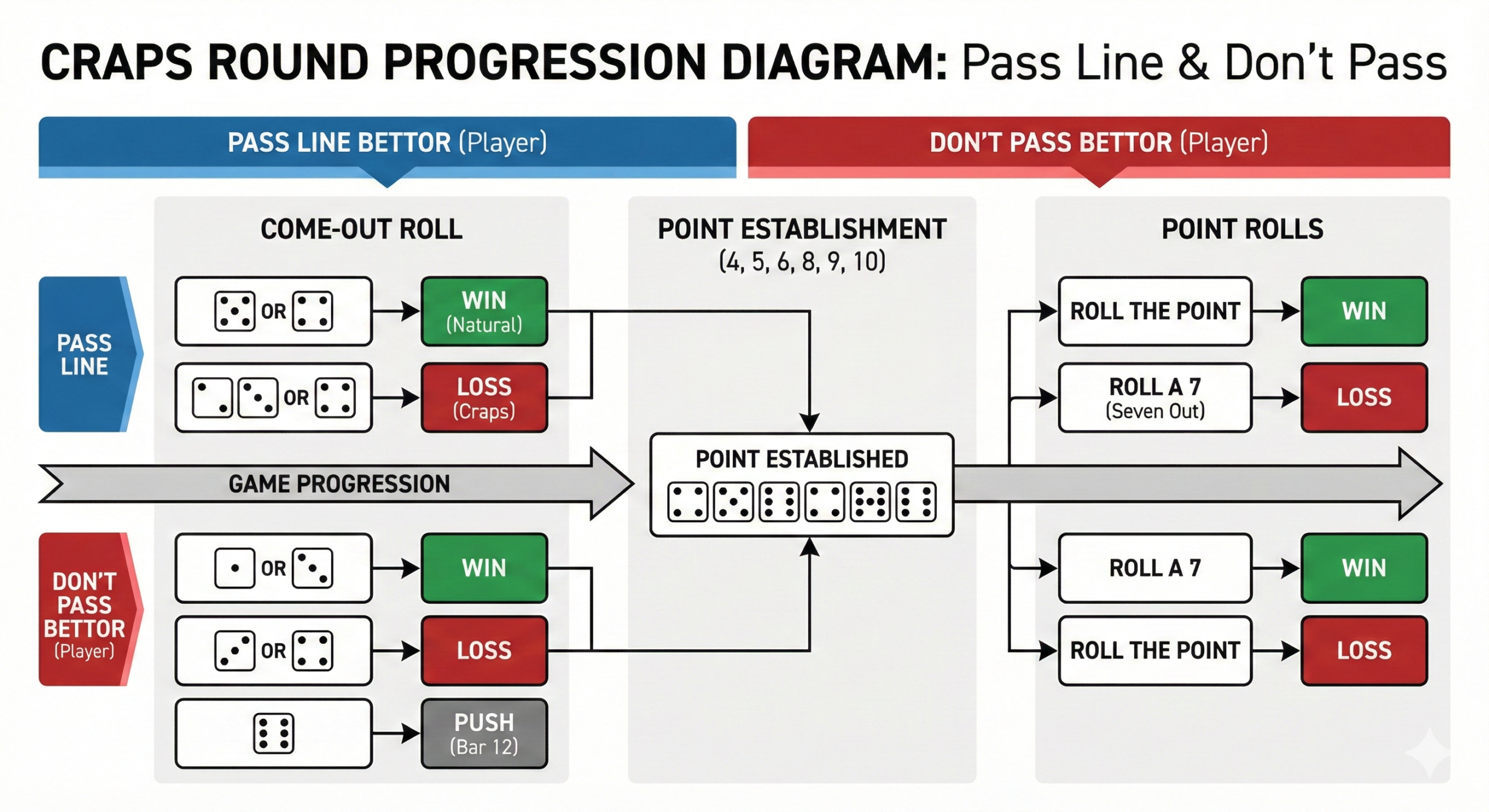
Phase 1: The Come-Out Roll
A new round begins. The shooter prepares to make the come-out roll. At this moment, the most common bet is on the Pass Line. The outcome of this roll is decisive:
-
Roll a 7 or 11: This is an immediate win for Pass Line bets.
-
Roll a 2, 3, or 12: This is “craps,” an immediate loss for Pass Line bets.
-
Roll a 4, 5, 6, 8, 9, or 10: This number becomes the “point.” A small “puck” marker is moved to that number on the table. The game now moves to the second phase.
Phase 2: Rolling for the Point
Once a point is established (let’s say the point is 8), the shooter’s goal is to roll that point number again before rolling a 7. The game continues, with players often placing additional bets.
-
Roll the Point (8): Pass Line bets win. The round ends, and the shooter keeps the dice for a new come-out roll.
-
Roll a 7 (“Seven-Out”): Pass Line bets lose. The round ends, and the dice pass to the next shooter.
Image Suggestion: A clear, labeled photograph of a craps table layout, with callouts pointing to the Pass Line, Don’t Pass Bar, and the Field.
Common Bets and Their Meanings
The table layout can be overwhelming, but it consists of a few key bet types. These are often divided into “contract” bets (made before the come-out) and “single-roll” bets.
Contract Bets (Multi-Roll Bets)
These bets stay in play until a decision is reached (a win or loss).
-
Pass Line Bet: The fundamental bet described above. You win on 7 or 11 on come-out; lose on 2,3,12; then win if the point is rolled before a 7.
-
Don’t Pass Bet: Essentially the opposite of the Pass Line bet. You win on come-out 2 or 3, push (tie) on 12, lose on 7 or 11. After a point is established, you win if a 7 is rolled before the point.
-
Come Bet: This works exactly like a Pass Line bet, but you place it after a point is established. The next roll becomes the “come-out” for your specific Come bet, and it then travels to its own point number.
-
Place Bets: You bet that a specific number (4,5,6,8,9, or 10) will be rolled before a 7. These can be made at any time.
Single-Roll Bets
These are resolved on the very next roll of the dice.
-
Any 7: Bets that the next roll will be a 7.
-
Any Craps: Bets that the next roll will be a 2, 3, or 12.
-
Field Bet: Bets that the next roll will be a 2, 3, 4, 9, 10, 11, or 12.
Understanding the Probabilities
Craps is a game fundamentally governed by the mathematics of two six-sided dice. The table below shows the true odds for rolling specific totals, which is the foundation for all game mechanics.
| Dice Total | Number of Combos | Probability | Common Name |
|---|---|---|---|
| 2 | 1 (1+1) | 2.78% | Snake Eyes |
| 7 | 6 | 16.67% | N/A |
| 12 | 1 (6+6) | 2.78% | Boxcars |
Note: This is a partial table for illustration. A full chart would list totals 2 through 12.
This probability framework explains why 7 is the most pivotal number and why certain bets have different payouts; they are designed around these immutable odds.
The Social Dynamics and Etiquette
Craps is unique for its collaborative spirit. Players often bet with the shooter on the Pass Line, creating a shared win. It’s common to hear cheers for specific numbers and collective groans on a seven-out. Standard etiquette includes using one hand to throw the dice (to prevent switching), ensuring they hit the back wall of the table, and handling bets through the table dealers, not directly.
Key Tips for Game Understanding
-
Start Simple: Focus on understanding the Pass Line bet and the round flow. This is the engine of the game.
-
The 7 is Pivotal: Remember, a 7 is a winner on the come-out roll but becomes the loser once a point is established. This flip is the core dramatic tension.
-
It’s a Game of Cycles: Rounds can be one roll or many rolls long. The volatility and excitement come from not knowing how long a “point phase” will last.
-
Observe First: The best way to learn the pace and placement of bets is to watch a few rounds unfold, noting where chips are placed on the table after each roll.
FAQ
Q1: Why is craps often cited in discussions about game probability?
Craps offers a transparent model of independent trials (dice rolls) with fixed probabilities. The ability to place an “odds bet,” which is paid at true mathematical odds with no house edge, is a rare and educationally significant mechanic in table game design, making it a prime case study.
Q2: Is it better to be the shooter?
Statistically, no. The dice have no memory, and the probabilities are identical for every roll, regardless of who throws them. Being the shooter is simply a ceremonial role that adds to the personal engagement and social fun of the game.
Q3: What are the “craps numbers”?
The “craps” numbers are 2, 3, and 12 on the come-out roll. Rolling these results results in an immediate loss for Pass Line bets. This rule is a foundational part of the game’s historical structure.
Q4: From a probability standpoint, what is the hardest number to roll?
Statistically, the 2 and the 12 are the hardest, as there is only one dice combination each (1-1 and 6-6) to make them, giving each a 1-in-36 (≈2.78%) chance per roll.
Q5: Can you “system beat” craps?
No. Craps is a game of independent chance with a fixed statistical framework. Every roll of fair dice is random and unaffected by previous rolls. Educational study focuses on understanding these probabilities, not overcoming them.
Personal Story
My first hands-on analysis of craps probability didn’t happen at a table; it happened in a 2018 game design workshop I attended in Seattle. Our small group was tasked with modeling the expected value of different bets using spreadsheet software. We simulated thousands of rolls, tracking the dizzying swings of a “hot” point phase and the inevitable regression to the mean. Watching the theoretical probability of the 7 (16.67%) manifest over thousands of simulated rolls was a powerful lesson in randomness. It grounded the game’s excitement in its mathematical reality, a perspective I carry into all my game mechanics writing.
Conclusion
Craps is a thrilling blend of chance, community, and complex, interwoven betting options rooted in clear probability. By understanding the two-phase round structure (come-out and point), the pivotal role of the number 7, and the basic categories of bets, the game’s logical framework comes into clear focus. Beyond the probabilities, its enduring appeal lies in the shared experience it creates—a collective breath held with each toss of the dice. Whether you’re studying game mechanics, probability theory, or social history, craps offers a masterclass in how simple rules can generate profound excitement and a rich subject for academic exploration.
Written by Alex Reed, a former math tutor and game mechanics enthusiast with over a decade of experience analyzing probability in tabletop and traditional games. Alex focuses on the historical and mathematical structures behind games of chance for educational audiences