Introduction
If you’ve ever walked through a casino floor, a fairground arcade, or even played a video game with a bonus round, you’ve likely encountered a slot machine. Their bright lights, captivating sounds, and promise of a big win are iconic. But behind the flashing spectacle lies a fascinating world of mathematics, technology, and psychology.
This article is a deep dive into the inner workings of slot machines from an educational perspective. We’ll strip away the mystery and look at the gears, both physical and digital, that make them tick. Our goal is to understand the how and why behind the reels. Whether you’re a game design student, a curious player, or just someone interested in technology, this guide will explain slot machines in simple terms.
From Lever to Server: A Brief History
Understanding today’s complex machines starts with a look at their humble beginnings.
The Liberty Bell and Mechanical Roots
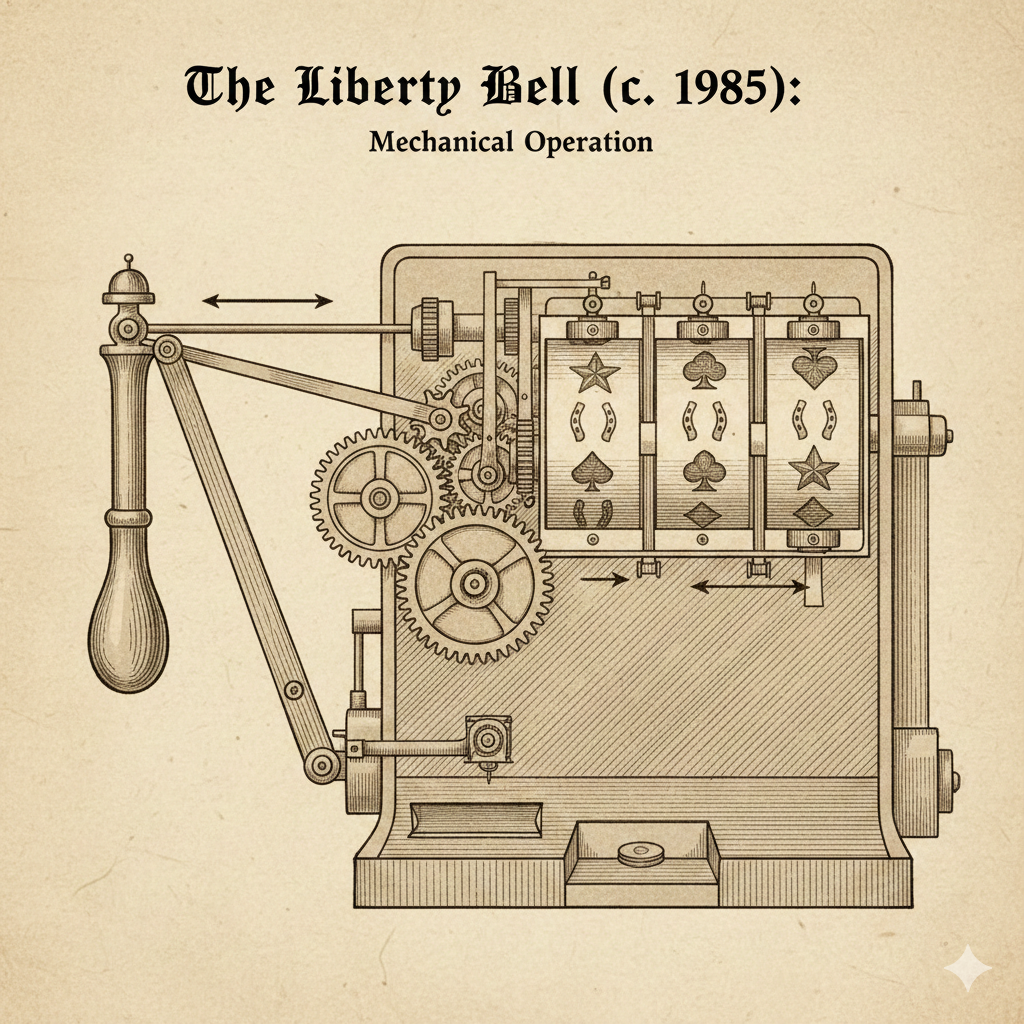
The first true slot machine was invented by Charles Fey in San Francisco around 1895. His “Liberty Bell” featured three physical reels with five symbols: horseshoes, diamonds, spades, hearts, and the Liberty Bell. Players pulled a lever to spin the reels, and a payout was made for matching symbols. The mechanism was purely mechanical, using springs, gears, and a braking system. The “one-armed bandit” nickname was born.
The Electromechanical Revolution
In the 1960s, machines began incorporating electrical components. This allowed for new features like flashing lights, sound effects, and, crucially, the potential for bigger jackpots. The lever became more of a tradition, with buttons taking over. The most significant change was the introduction of the “hopper,” an electrically-powered coin dispenser that automated payouts.
The Digital Age: RNGs and Video Slots
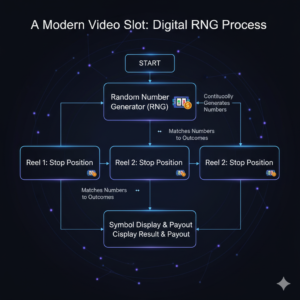
The true revolution came with the microprocessor. Modern slot machines are essentially specialized computers. The physical reels were replaced by video screens simulating reels, allowing for more symbols, complex bonus games, and intricate themes. The heart of the modern machine is no longer a gear, but a piece of software.
The Brain of the Machine: Random Number Generators (RNG)
This is the single most important concept in understanding modern slots.
What is an RNG?
An RNG is a computer program that constantly generates a sequence of random numbers, thousands every second. When you press the “spin” button, the RNG stops at the most recent number (or a set of numbers). This number is instantly mapped to a specific combination of symbols on the virtual reels. The outcome is determined the millisecond you press the button; the spinning animation is just for show.
The Illusion of “Due” Wins
Because each spin is an independent event governed by the RNG, the machine has no memory. It does not “get hot” or “cold,” and it is never “due” for a win. The result of your last spin, or the last hundred spins, has absolutely no bearing on your next spin. This concept of true randomness is key to understanding their operation.
The Blueprint: Understanding Payback and Odds
How does a game manufacturer ensure the machine operates on a sustainable mathematical model? The answer lies in the blueprint.
Return to Player (RTP)
RTP is a theoretical percentage. If a machine has an RTP of 95%, it means that, over an extremely long period of time and millions of spins, it is programmed to pay back 95% of all money wagered. The remaining percentage is the mathematical edge built into the game’s design. It’s crucial to remember this is a long-term statistical average, not a short-term guarantee.
Hit Frequency vs. Payout Size
These two concepts work in tandem. Hit frequency refers to how often a machine will land a winning combination (any win, big or small). A high-hit-frequency machine might pay out small wins often. A low-hit-frequency machine pays less frequently, but the wins can be larger. Game designers carefully balance these to create a desired player experience.
Volatility (or Variance)
This describes the risk level of a slot. Low-volatility slots offer frequent, smaller wins, providing longer playtime. High-volatility slots have fewer wins, but when they hit, the payouts can be substantial. Choosing between them is about preferred play style.
Beyond the Basic Spin: Common Features Explained
Modern slots are packed with features designed to make gameplay more engaging.
Paylines and Ways to Win
Early slots had a single payline across the center. Today, machines can have dozens, hundreds, or even hundreds of thousands of “ways to win.” Instead of matching symbols on a specific line, these games pay for matching symbols on adjacent reels, starting from the leftmost reel. For an illustration: Imagine a 5×3 grid (5 reels, 3 rows). A “243 ways to win” game means you win if you get matching symbols on any adjacent reels starting from reel 1—no specific line needed.
Wild Symbols
Acting like a joker in a card game, a Wild symbol can substitute for almost any other standard symbol to help complete a winning combination. They are a game designer’s tool to increase hit frequency and excitement.
Scatter Symbols and Bonus Rounds
Unlike other symbols, Scatters typically pay based on how many appear anywhere on the reels, not on a specific line. Getting enough Scatters usually triggers a Bonus Round—a special game, often with free spins, multipliers, or a pick-and-win interactive feature. This is where much of a game’s theme and big-win potential come alive.
Progressive Jackpots
These are jackpots that grow over time. A tiny fraction of every bet placed on a linked network of machines is added to a central, cumulative prize pool. This jackpot can grow to be very large. It’s won via a rare, randomly-triggered event or by landing a specific maximum-symbol combination.
The Psychology of Play: Sight, Sound, and Sensation
Slot machine design is a masterclass in user experience (UX) psychology, all aimed at creating an immersive flow.
Audiovisual Feedback
Every win, no matter how small, is celebrated with cheerful sounds and flashing lights. This positive reinforcement triggers a dopamine release in the brain, associating the action (spinning) with a reward (winning sounds). Even “losses disguised as wins” (when you win back less than your bet but still hear the victory tune) use this principle.
Thematic Immersion
Slots are no longer just fruits and bells. They are mini-adventures based on movies, mythology, fantasy, and history. High-quality graphics, storylines, and character development pull the player into the narrative, making the gameplay about more than just the outcome.
The Near-Miss Effect
When two jackpot symbols land on the payline with the third just above or below it, it feels tantalizingly close. Research suggests these “near-misses” can be as stimulating as actual wins for some players, encouraging continued play in pursuit of the “almost-got-it” feeling. This is a well-documented aspect of game design psychology.
FAQ
Q1: Are online slot machines rigged?
Legitimate, regulated online gaming platforms use certified RNG software that is regularly audited by independent testing agencies (like eCOGRA or iTech Labs) to ensure fairness and randomness. The odds and RTP are published in the game’s information or paytable.
Q2: Is there a “best time” to play a slot machine to win?
No. Since every spin is an independent, random event governed by the RNG, the time of day, day of the week, or how long a machine has been played does not affect your odds. The outcome is determined in a nanosecond when you hit spin.
Q3: What does “weighted” mean in terms of slot reels?
In a physical-reel machine, “weighting” meant certain symbols were represented more times on the physical reel strip, making them more likely to land. In digital slots, this is simulated. Each virtual “reel strip” is a digital array, and symbols are distributed unevenly to create the desired hit frequency and RTP.
Q4: Can you tell if a machine is about to hit a jackpot?
No. There are no tell-tale signs, patterns, or cycles. The RNG’s operation is continuous and instantaneous. The notion of a machine “primed” to pay is a persistent myth. Each spin is a completely fresh, random event.
Q5: What’s the difference between a slot machine and a video poker machine?
While they may look similar, video poker is a game of skill based on five-card draw poker. Your decisions (which cards to hold) directly influence the odds. A slot machine is purely a game of chance; your only decision is when to initiate the spin.
Important Educational Disclaimer
This article is for educational and entertainment purposes only. It aims to explain the technological and mathematical mechanics behind slot machine design. Understanding these mechanics does not guarantee any specific outcome, as results are always randomly generated. Gambling should never be viewed as a way to earn money. If you choose to play, please do so responsibly, set strict limits for time and money, and never chase losses.
For more information on responsible gaming practices and certified RNG testing, you can visit the website of eCOGRA, a leading international testing agency.
Personal Story
When I was studying game design in college, our professor brought in an old, decommissioned mechanical slot machine. Our assignment was to trace the entire mechanical process from pulling the lever to the reels stopping.
Spending hours mapping how a notch on one gear would release a brake on another, and how the metal “kickers” would interact with the reel notches, was a revelation. It turned a magical, mysterious box into a brilliant, clunky, and utterly logical machine.
It taught me that understanding the mechanics—whether gears or code—demystifies technology and fosters a much deeper appreciation for the design, math, and psychology involved in creating engaging systems.
Conclusion
Slot machines are a captivating blend of history, mathematics, computer science, and behavioral psychology. They evolved from simple mechanical devices into sophisticated software platforms designed to provide specific entertainment experiences.
The core principle remains: modern slots operate on Random Number Generators, ensuring each spin is independent and random, governed by a precise mathematical blueprint (RTP and volatility). By understanding concepts like RNGs, hit frequency, and the psychology of feedback, we can appreciate them as complex entertainment systems.
This knowledge allows us to engage with the topic from an informed and educational perspective, focusing on the fascinating mechanics of game design rather than outcomes.
1 thought on “Slot Machines Explained: How They Really Work”