Introduction
Poker is one of the most popular card games in the world, enjoyed for its combination of strategy, probability, and skill. While many associate poker with casinos, this article focuses on the educational aspects, including rules, mechanics, and terminology. Learning poker is a great way to develop analytical and decision-making skills, even if you’re not playing for real money.
What Is Poker?
Poker is a card game played in many variants. The objective is to create the best possible hand according to the hand rankings of that variant. Players combine their cards with community cards (depending on the version) to form winning combinations.
Common poker variants include:
- Texas Hold’em
- Omaha
- Seven-Card Stud
- Five-Card Draw
All variants involve strategic thinking, probability calculations, and pattern recognition, making them excellent for educational purposes.
Basic Poker Rules
Hand Rankings
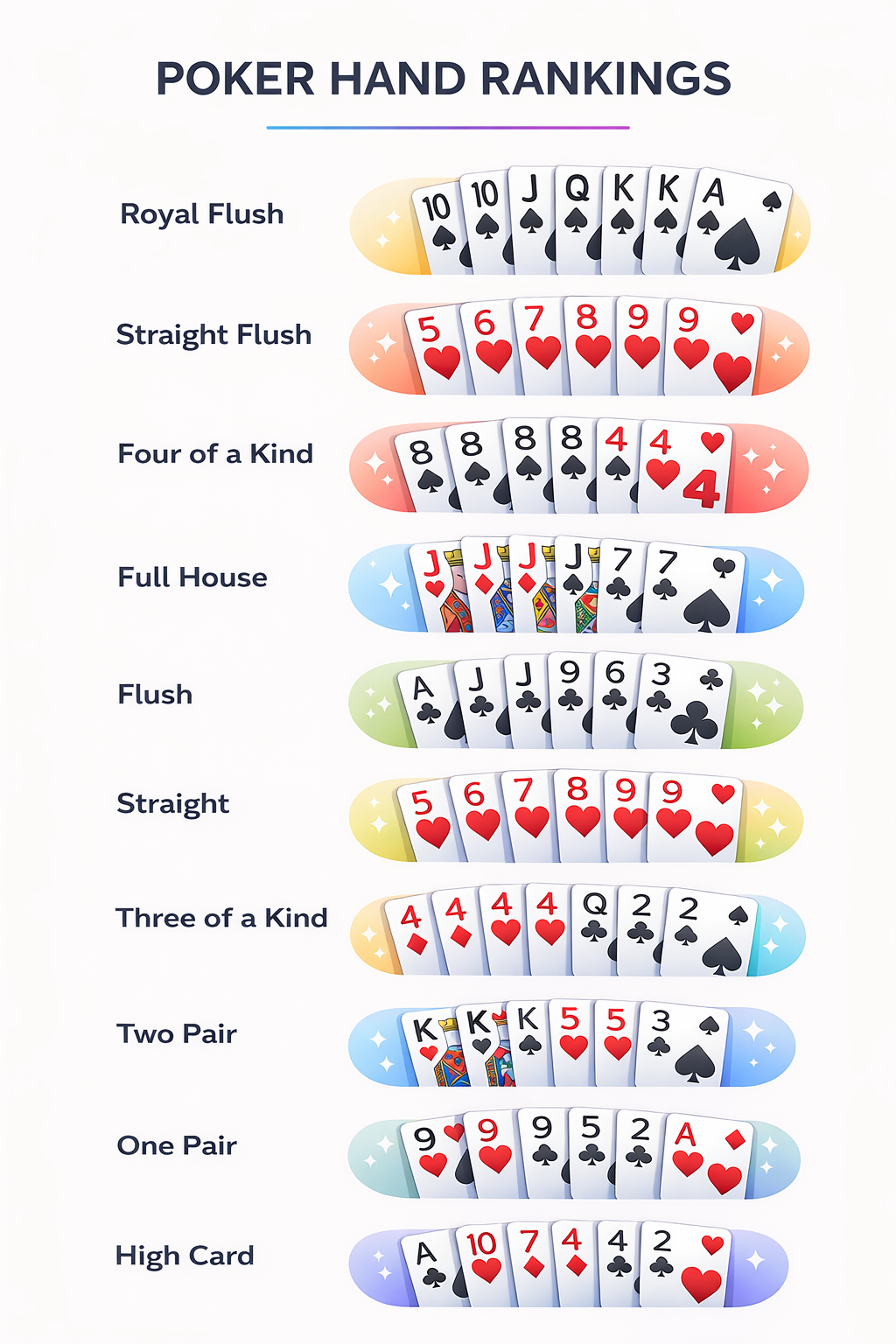
Understanding hand rankings is essential. From highest to lowest:
-
Royal Flush: Ace, King, Queen, Jack, Ten of the same suit
-
Straight Flush: Five consecutive cards of the same suit
-
Four of a Kind: Four cards of the same rank
-
Full House: Three of a kind plus a pair
-
Flush: Five cards of the same suit
-
Straight: Five consecutive cards of different suits
-
Three of a Kind: Three cards of the same rank
-
Two Pair: Two different pairs
-
One Pair: Two cards of the same rank
-
High Card: The highest card when no combination is made
Betting Rounds
Most poker games involve multiple betting rounds:
-
Pre-Flop: Players receive their cards; initial betting begins
-
Flop: Three community cards are revealed
-
Turn: The fourth community card is revealed
-
River: The fifth and final community card is revealed
Players make decisions like folding, calling, or raising in each round, depending on the variant and strategy.
Poker Mechanics Explained
Poker is not just about luck — it involves strategy and probability.
Key mechanics:
-
Card Probability: Knowing the chances of forming specific hands helps make informed decisions
-
Position: Acting later in a round provides a strategic advantage
-
Bluffing (Educational Only): Representing a stronger hand than you have for learning purposes
-
Pot Odds: Calculating whether the potential reward justifies the risk
Remember: This content is for educational purposes only.
Common Poker Terms
-
Blinds: Forced bets made before cards are dealt (small blind, big blind)
-
Flop / Turn / River: Community cards revealed in Texas Hold’em
-
Fold: Giving up your hand
-
Call: Matching the current bet
-
Raise: Increasing the bet amount
-
Showdown: When the remaining players reveal their hands to determine the winner
Strategy Theory (Educational Only)
Learning poker strategies improves analytical skills:
-
Starting Hand Selection: Which hands to play based on probability
-
Position Awareness: Acting last allows better decision-making
-
Basic Betting Concepts: Understanding risk versus potential reward
Focus on learning game mechanics and strategy theory rather than playing for money.
Conclusion
Poker is a fascinating card game that combines skill, strategy, and probability. By understanding rules, mechanics, and hand rankings, beginners can develop valuable analytical skills in a safe and educational environment.
FAQ
Q1: Is poker only played for money?
A1: No. Poker can be played for enjoyment and learning without any financial risk or gambling.
Q2: Do I need experience to play poker?
A2: Beginners can start with hand rankings, basic rules, and strategy theory.
Q3: Which poker variant is easiest for beginners?
A3: Texas Hold’em, because of its simple rules and community cards.
Q4: Can poker improve skills outside gaming?
A4: Yes. Poker develops probability analysis, strategy, and decision-making skills.
Q5: Are there educational apps for learning poker?
A5: Yes. Free apps and simulators help practice rules and strategies safely.
Responsible Gaming Note
Note: This article is for educational purposes only. Always enjoy games responsibly. For more information about responsible gaming, visit BeGambleAware.
My Story: How I Started Learning Poker
When I first encountered poker, I assumed it was merely a game of chance. Yet, as I immersed myself in the rules and mechanics, I uncovered a rich world of strategy, probability, and critical thinking. I dedicated countless hours to studying guides, practicing with friends, and exploring free online simulators to grasp how hands worked and how different strategies shaped the outcomes.
As I delved deeper, I realized that poker cultivates essential life skills. I honed my ability to make informed decisions under uncertainty, analyze various options, and anticipate future moves — all while avoiding any financial risk.
This journey inspired me to create A2Z Gaming Guides: a resource dedicated to sharing my insights in a safe, educational, and structured manner. My goal is to help beginners like you enjoy the process of learning about games without any pressure or risk.
I truly hope this guide serves as a valuable starting point for you and ignites your passion for exploring games that offer both learning and fun, just as it did for me.
3 thoughts on “How Poker Works: Rules, Mechanics & Game Basics”