Disclaimer: This article is for educational purposes only. It explains the rules and history of baccarat as a card game. Always engage with games responsibly and within appropriate contexts.
Introduction
Baccarat, with its sleek tables and aura of sophistication, is a classic card game featured in countless films and novels worldwide. While it may appear complex, its core principle is beautifully simple: it’s a comparison game between two hands, the “Player” and the “Banker.”
This educational guide will demystify baccarat, breaking down its fundamental rules and exploring popular variations. Our focus is purely on the mechanics, history, and structure of the game itself, perfect for understanding its role in culture and simulation.
The Core Objective and Card Values
Before any cards are dealt, understanding the scoring system is crucial. In baccarat, the goal is to have a hand with a total value as close to 9 as possible.
Understanding Card Values
-
Cards 2 through 9 = Face value.
-
10, Jack, Queen, King = 0 points (often called “baccarat”).
-
Ace = 1 point.
Calculating a Hand Total
The total of a hand is the sum of the card values, but with a unique twist: only the last digit of the total counts. If the sum exceeds 9, you drop the first digit.
-
Example 1: A hand of 7 and 2 equals 9 (a “natural”).
-
Example 2: A hand of 8 and 7 equals 15. You drop the tens digit (the 1), leaving a value of 5.
-
Example 3: A hand of King (0) and 6 equals 6.
This “modulo 10” system is the mathematical heart of the game.
How to Play a Standard Round (Punto Banco)
The most widespread version globally is Punto Banco, where the game is governed by fixed rules.
Step-by-Step Round Flow
-
The Deal: The dealer gives two cards each to the Player and Banker boxes.
-
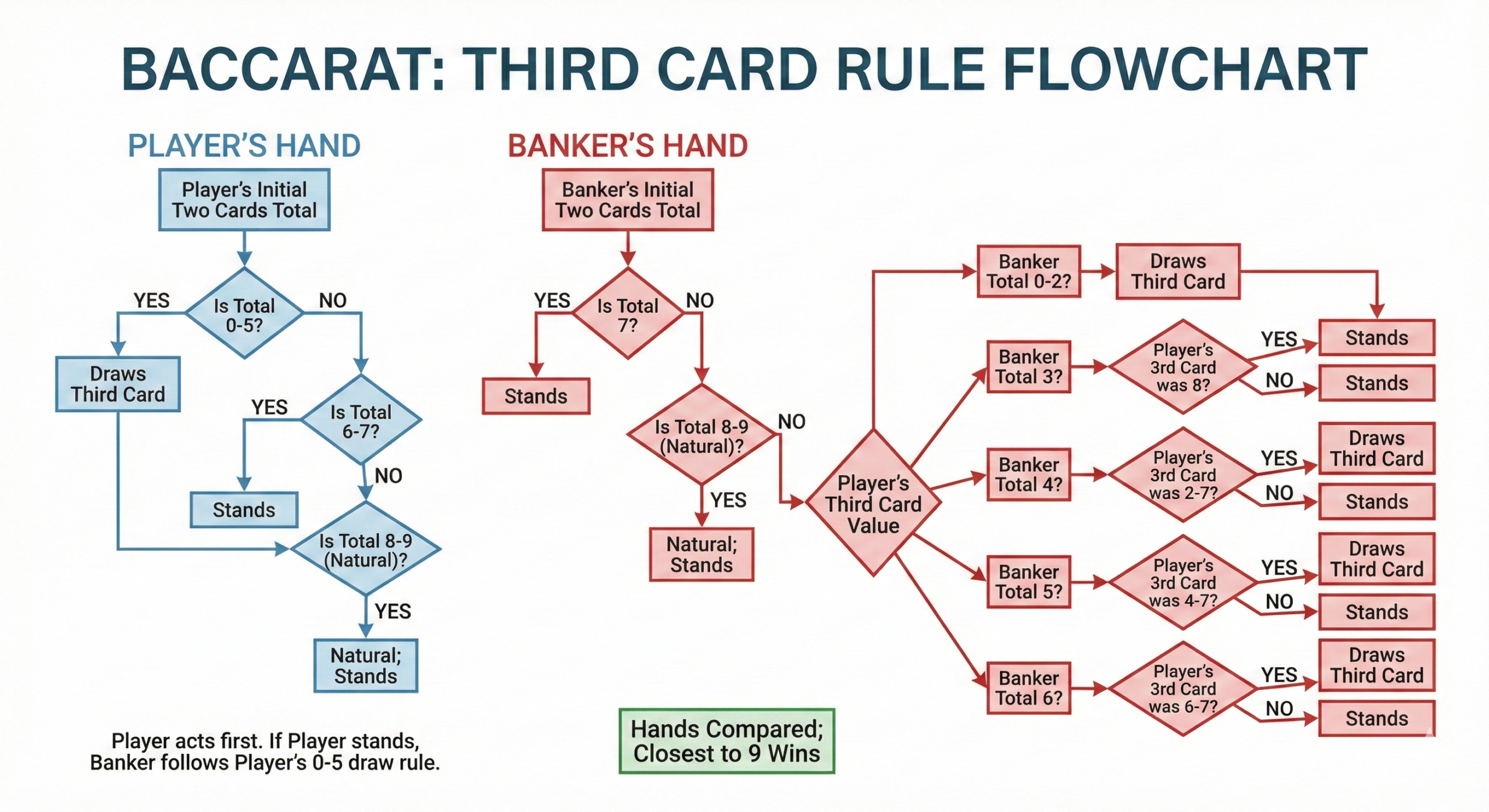
The Third Card Rule: This is automated. Whether a third card is drawn depends on strict, predetermined rules. The Player hand acts first.
-
Player: Draws on 0-5, stands on 6-7. A natural 8 or 9 ends the round.
-
Banker: Action depends on its own total and the Player’s third card (if drawn). These fixed rules are used in all modern simulations to ensure consistency.
-
-
Determining the Winner: After all cards are dealt, the hand closest to 9 wins. The game’s design includes standard mechanics, such as a commission on Banker wins, which are part of its historical scoring structure.
Illustration Idea: A three-panel diagram showing: 1) Initial two-card deal, 2) Third card draw decision flow, 3) Final hand comparison.
Popular Game Variations
While Punto Banco is the default, other historical and regional variations exist.
Chemin de Fer
This is the classic French version. It is a more interactive game where players take turns being the “Banker,” opposing the table. The Banker decides whether to draw a third card, adding a layer of personal strategy.
Baccarat Banque
Here, one player is the Banker for the entire shoe. The Banker plays against two other player hands. The rules for drawing are fixed, but the enduring Banker position changes the social dynamic.
Mini-Baccarat
This is a format variation of Punto Banco. Played on a smaller table with a faster pace, the dealer handles all cards. The rules are identical, making it an accessible format for learning.
Key Terminology for Beginners
Speaking the language helps demystify the game.
-
Punto: Player.
-
Banco: Banker.
-
Coup: A single round.
-
Natural: A two-card total of 8 or 9.
-
Stand: To not draw a card.
-
Shoe: The device holding multiple decks.
Common Misconceptions and Tips for Enjoyment
Let’s clear up a few things. The “Banker” is simply one of two possible outcomes in Punto Banco, not an opponent. The game is fascinating for its blend of simple choice (which hand to back) and complex, fixed rules governing the draw.
For optimal enjoyment in study or simulation:
-
Appreciate the suspense created by the automated drawing rules.
-
Understand the game as a cultural artifact with a rich history.
-
Focus on the probability and mechanics rather than any outcome.
FAQ
Q1: Is baccarat a game of pure luck, or is there skill involved?
In Punto Banco, the outcome is determined by the cards dealt and fixed drawing rules. The participant’s choice is limited to the initial prediction. Variations like Chemin de Fer involve more strategic decision-making for the participant acting as Banker.
Q2: Why is there often a commission on the banker’s outcome?
This is a foundational game mechanic. Due to the rules governing when the Banker draws, it has a slight statistical advantage in Punto Banco. The commission is a built-in part of the game’s scoring design to balance this.
Q3: What’s the difference between a “Tie” and a “Pair” bet?
A “Tie” bet wins if the final Player and Banker totals are identical. A “Pair” side bet (in some games) is that the first two cards in a hand will be of the same rank (e.g., two Kings). They are separate wagers with different odds.
Q4: How many decks are used?
Punto Banco is commonly played with 6 or 8 standard decks shuffled together in a shoe. Using multiple decks is standard for this version.
Personal Story
I first learned baccarat not in a casino, but around a kitchen table with a worn deck of cards and a group of friends. We used buttons as chips, and I was tasked with being the dealer, meticulously following a printed-out “third card rule” chart.
What struck me was the collective suspense. With every reveal, everyone leaned in, not because of the stakes, but simply to see if our predictions were right. That evening taught me that at its core, baccarat is a beautifully simple game of anticipation—a probability lesson wrapped in a timeless ritual. It’s that same feeling of elegant suspense I now appreciate when studying its mechanics and history.
Conclusion
Baccarat’s elegance lies in its straightforward premise and structured play. We’ve explored the unique scoring system, walked through a standard round of Punto Banco, and highlighted key variations like the more interactive Chemin de Fer.
Whether you encounter it in a historical context, a film, or a digital simulation, understanding these fundamentals allows you to appreciate baccarat as a fascinating game of chance with a rich heritage. By focusing on the mechanics and terminology, you can enjoy the strategic depth of its variations and the pure, suspenseful thrill of the reveal, which has captivated players for centuries.