Disclaimer: This article is for educational and entertainment purposes only. It explains the mathematical and mechanical concepts behind the game of roulette as it appears in simulations, video games, and theoretical contexts. It does not promote or provide advice for real-money gambling.
Introduction
Welcome to another deep dive into the fascinating world of game mechanics! Today, we’re exploring a classic that has captivated players for centuries: roulette. More than just a spinning wheel, it’s a brilliant case study in probability, design, and game theory.
We will unpack the math behind the wheel, break down the official odds, and tour the different versions of the game you might encounter in simulations or educational apps. Let’s spin the wheel of knowledge!
The Heart of the Game: Understanding the Roulette Wheel
The roulette wheel is a masterpiece of balanced chaos. At first glance, it seems like a random jumble of numbers, but its layout is meticulously engineered to ensure fairness and unpredictability in its spin.
The Two Main Wheel Layouts
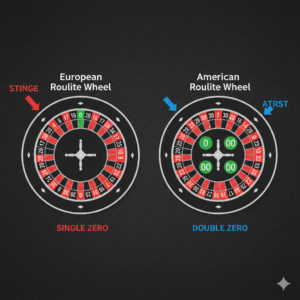
There are two primary wheel designs, and knowing which one you’re looking at is crucial to understanding the game’s math.
-
The European Wheel: This version has 37 pockets. Numbers 1 through 36 alternate between red and black. A single green pocket is numbered 0.
-
The American Wheel: This version has 38 pockets. It includes the numbers 1-36 (red and black) plus two green pockets: 0 and 00. This extra pocket is the key difference that changes the game’s odds dramatically.
The Language of the Table: Bets and Payouts
The betting table is where players place their chips. Bets fall into two main categories: “Inside Bets” on specific numbers and “Outside Bets” on larger groups.
Inside Bets (Higher Risk, Higher Payout)
These are bets placed on the numbered grid or the lines between numbers.
-
Straight Up: Betting on a single number. Payout: 35 to 1.
-
Split: Betting on two adjacent numbers by placing a chip on the line between them. Payout: 17 to 1.
-
Street: Betting on three numbers in a row (e.g., 1, 2, 3). Payout: 11 to 1.
-
Corner: Betting on a block of four numbers (e.g., 1, 2, 4, 5). Payout: 8 to 1.
-
Line: Betting on two adjacent rows, covering six numbers (e.g., 1-6). Payout: 5 to 1.
Outside Bets (Lower Risk, Lower Payout)
These are bets placed on the designated areas outside the number grid.
-
Red/Black: Betting on the color. Payout: 1 to 1 (even money).
-
Odd/Even: Betting on whether the winning number is odd or even. Payout: 1 to 1.
-
High/Low: Betting on 1-18 (Low) or 19-36 (High). Payout: 1 to 1.
-
Dozens: Betting on 1-12, 13-24, or 25-36. Payout: 2 to 1.
-
Columns: Betting on one of the three vertical columns of 12 numbers. Payout: 2 to 1.
The Unavoidable Math: House Edge and Probability
This is the educational core. Every casino-style game has a built-in mathematical advantage for the house, called the “house edge.” Roulette provides one of the clearest examples of how this works. For a deeper understanding of the core principles at play, you can explore the concept of probability theory on Britannica.
Calculating Probability
Probability is simply: (Number of Winning Outcomes) / (Total Number of Possible Outcomes).
-
On a European (single-zero) wheel, the probability of hitting a single number is 1/37, or about 2.70%.
-
On an American (double-zero) wheel, the probability is 1/38, or about 2.63%.
Understanding the House Edge
The house edge comes from the payout not matching the true odds. Let’s use an Even-Money bet (like Red) as an example:
-
On a European wheel, there are 18 reds, 18 blacks, and 1 green zero. If you bet $1 on red, you have 18 ways to win and 19 ways to lose (18 blacks + 1 green zero).
-
Your true odds of winning are 18/37, or 48.65%. The house edge is the difference between the true odds and the payout odds. The formula works out to a 2.70% house edge for European Roulette.
-
On an American wheel, you have 18 reds, 18 blacks, and 2 green zeros (0 and 00). Your chances of winning a red bet are 18/38, or 47.37%. This creates a house edge of 5.26%—almost double!
This edge is guaranteed over the long run, which is why in game design, it’s considered the cost of playing the game’s exciting format.
A Tour of the Felt: Common Game Types
You’ll find these variations in both physical and digital game simulations.
European Roulette
The standard in most of the world. Featuring a single zero, it offers the best standard odds for players with its 2.70% house edge. It’s the most common version in educational apps due to its straightforward math.
American Roulette
Identified by the double-zero (00) pocket. The extra pocket increases the house edge to 5.26% on most bets. It’s a great version to study to see how a small rule change dramatically impacts probability.
French Roulette
Played on a single-zero European wheel but with two special player-friendly rules:
-
La Partage: If you make an even-money bet and the ball lands on zero, you lose only half your bet.
-
En Prison: Under this rule, if the ball lands on zero on an even-money bet, your bet is “imprisoned” for the next spin. If it wins on the next spin, you get your original bet back (no profit). These rules cut the house edge on even-money bets in half, to about 1.35%.
Frequently Asked Questions (FAQ)
Q: Is there a betting strategy that can beat the math of roulette?
A: No mathematical strategy can overcome the built-in house edge in the long run. Strategies like the Martingale (doubling your bet after a loss) can change your short-term experience, but they don’t alter the underlying probability of each spin, which is always independent. They also require a theoretically infinite bankroll, which doesn’t exist in practice.
Q: Which roulette type gives the player the best odds?
A: From a purely mathematical standpoint, French Roulette with the “La Partage” or “En Prison” rules offers the lowest house edge (1.35%) on even-money bets. Standard European Roulette (2.70% edge) is next, followed by American Roulette (5.26% edge).
Q: Why is green always used for the zero(s)?
A: Historically, the green color was chosen simply to provide a clear, distinct contrast against the red and black numbers, preventing any confusion on the betting table. It’s a design choice that became a universal standard.
Q: Are the numbers in a random order on the wheel?
A: Yes, but it’s a balanced randomness. Wheel designers arrange numbers so that high and low, odd and even, and red and black are distributed as evenly as possible around the wheel. This helps ensure a physically balanced spin and prevents consecutive numbers from being adjacent.
A Personal Story
My first real understanding of roulette math didn’t come from a casino, but from a high school science fair. A classmate built a magnificent, fully functional wooden roulette wheel for a project on probability. We spent lunch hours spinning it, tracking results on a giant spreadsheet.
I’ll never forget the moment we hit the same number three times in a row. We were ecstatic! Then, we crunched the numbers. While it felt like a miraculous streak, our data—over 2,000 spins—showed the distribution of red/black/odd/even creeping closer and closer to the exact percentages predicted by probability theory. That wheel taught me more about the law of large numbers and the difference between short-term luck and long-term math than any textbook ever could.
Visual Aid Suggestion
A Dynamic “House Edge Comparator” Diagram.
This would be an interactive or animated graphic (using fictional currency) showing two wheels—European and American—spinning simultaneously over, say, 100 simulated spins. A running tally on the side would track a player making constant $1 “Red” bets.
The key would be to visually show how the bank’s fictional balance grows slightly faster with the American wheel due to the higher house edge, despite both wheels producing similar short-term winning and losing streaks. This makes the abstract concept of “house edge” visually concrete.
Conclusion
Roulette is a captivating blend of simple choice and complex probability. We’ve seen how the core mechanics—the wheel layout, the betting options, and the payout structure—all intertwine to create a game with a predictable mathematical outcome over time.
The key takeaways are: the house edge is an immutable part of the game’s design, the type of wheel (European vs. American) dramatically changes your odds, and no strategy can circumvent the underlying math. Whether you encounter roulette in a history lesson, a probability class, or a story-driven video game, you can now appreciate the intricate design and elegant mathematics spinning at its heart. Thanks for learning with us!