Introduction: More Than a Game of Chance
Blackjack, often portrayed in popular culture as a casino staple, presents one of the purest intersections of probability, imperfect information, and sequential decision-making in gaming. From a game theory perspective, it is a finite, repeated game with defined rules and calculable outcomes.
This guide deconstructs Blackjack not as a gambling endeavor, but as a theoretical framework for understanding statistical variance, risk assessment, and optimal decision-making under constraints. We will explore its hierarchical mechanics, the mathematical bedrock of its odds, and the strategic heuristics that can maximize a player’s theoretical performance, all while treating the game as a compelling mental exercise.
Part 1: The Hierarchical Mechanics of Card Distribution and Action
Blackjack is a game of structured turns and constrained choices, creating a clear model for analyzing agent-based interaction.
The Core Objective and Card Valuation
The goal is to construct a hand where the sum of card values is closer to 21 than the dealer’s hand, without exceeding 21. Cards 2-10 are worth their face value, face cards (Jack, Queen, King) are worth 10, and an Ace can be worth 1 or 11. This dual-value Ace introduces critical flexibility, forming what is known as a “soft” hand (e.g., Ace + 6 = 7 or 17).
Sequence of Play and Information Asymmetry
The game proceeds in a strict sequence:
-
Each participant receives two cards. Player cards are typically dealt face up; the dealer has one card face up (the “upcard”) and one face down. This creates information asymmetry—a fundamental game theory concept where players have different levels of private information. You know your full hand and one of the dealer’s cards, but not their hidden card.
-
Players act in turn based on this incomplete information. Options are:
-
Stand: Keep the current hand total.
-
Hit: Request an additional card.
-
Double Down: Double the initial stake (conceptualized as a commitment to strategic investment) and receive exactly one more card.
-
Split: If the first two cards are of the same rank, split them into two separate hands, each with its own subsequent decisions.
-
Surrender: Forfeit half the stake to end the hand immediately (if the rule is offered).
-
-
The dealer acts last, following a fixed, non-discretionary rule: typically, they must hit on any hand totaling 16 or less and stand on 17 or more.
This final rule is paramount. The dealer has no strategic freedom, which means all player decisions are made against a predictable, probabilistic endpoint. Your strategy must be built around forecasting the likely outcomes of the dealer’s fixed rule set.
Part 2: The Mathematical Framework: Calculating Probability and Expected Value
At its heart, Blackjack is a probability puzzle. While complex due to card removal effects (the fact that cards dealt change the composition of the remaining deck), we can establish foundational probabilities.
Basic Probability Calculations
The probability of drawing any specific value card from a fresh, single deck is straightforward. For example, the chance of drawing a ten-value card (10, J, Q, K) is:
P(Ten)=1652≈30.77%
The probability of busting on a hit is a more practical calculation. If you hold a hand total of 12, you bust if you draw a ten-value card (10, J, Q, K) or an Ace (if counting Ace as 11 pushes you over 21). That’s 20 cards (16 tens + 4 aces) out of approximately 52, or a bust probability of roughly 38.5%. This probability increases non-linearly as your hand total increases from 12 to 16.
The Concept of Expected Value (EV)
-
A positive EV decision contributes to long-term theoretical performance.
-
A negative EV decision detracts from it.
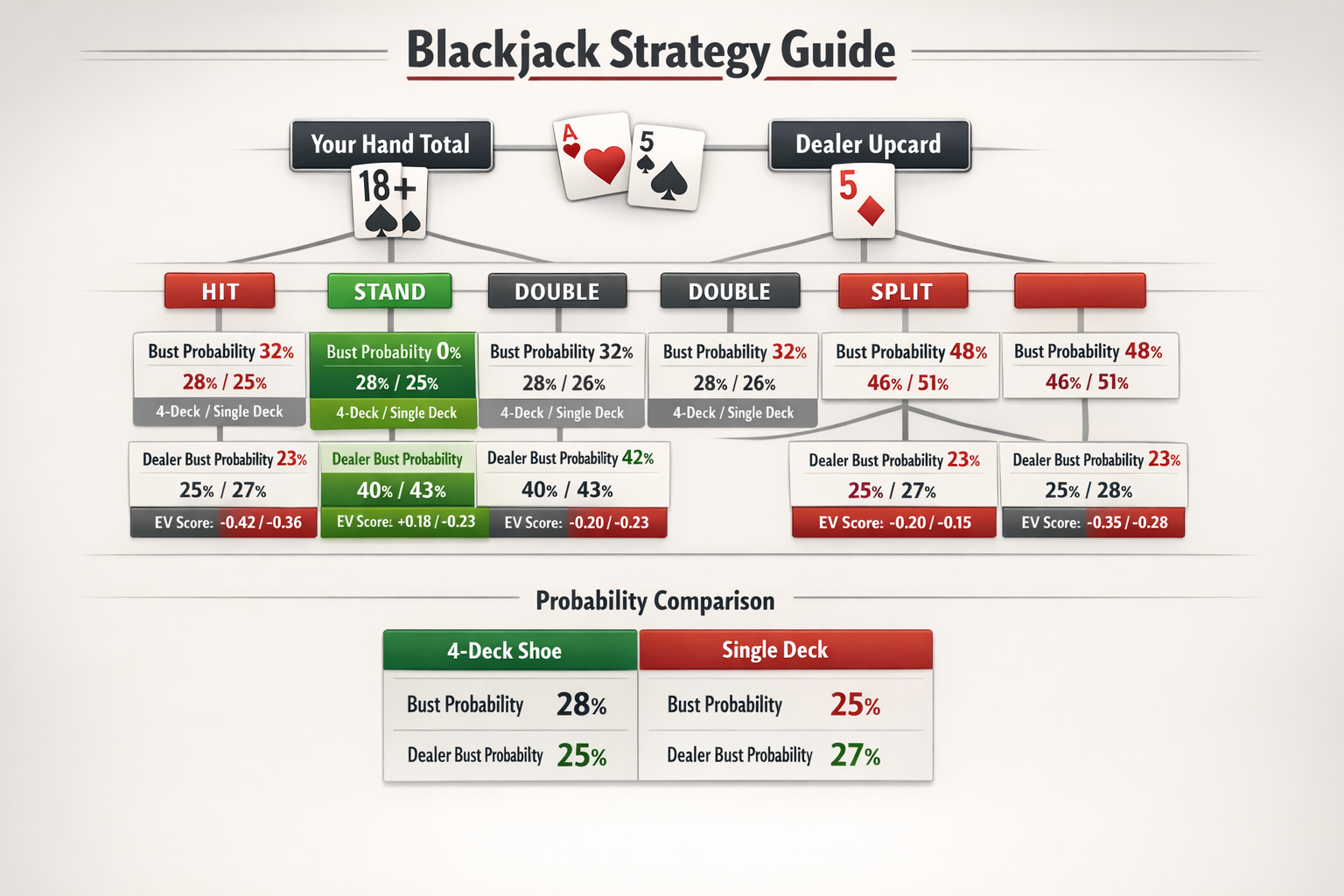
For example, the decision to hit or stand on 16 against a dealer 10 is determined by calculating the EV of both choices, considering all possible card draws and subsequent dealer outcomes. Basic Strategy (see below) is essentially a map of the highest-EV decision for every possible player hand and dealer upcard combination.
Part 3: Strategic Heuristics – The Blueprint of Basic Strategy
Basic Strategy is a set of optimal decisions derived from statistical simulation and probability theory. It accounts for the player’s hand, the dealer’s upcard, and the game rules to maximize expected value. It is the Nash Equilibrium for the player’s side of the game—the strategy that cannot be exploited and yields the best possible outcome against the dealer’s fixed strategy.
Comparative Analysis of Hand Scenarios
The table below illustrates optimal Basic Strategy decisions for key hand types, demonstrating how the information asymmetry of the dealer’s upcard dramatically alters the correct play.
| Your Hand | Dealer’s Upcard (7) | Dealer’s Upcard (10) | Game Theory Rationale |
|---|---|---|---|
| Hard 16 (e.g., 10+6) | Stand | Hit | Vs. 7, dealer has high bust chance. Vs. 10, you are likely losing unless you improve; standing is a guaranteed loss more often than hitting and busting. |
| Soft 18 (Ace+7) | Stand | Hit/Double* | Vs. a weak 7, your 18 is strong. Vs. a powerful 10, you must be aggressive to compete. (*Double if allowed, else Hit). |
| Pair of 8s | Split | Split | 16 is a terrible hand. Splitting turns it into two hands starting with 8, a much more flexible and promising total. |
| Hard 12 (e.g., 10+2) | Hit | Stand | Vs. 7, the dealer is strong; you must try to improve. Vs. 10, the dealer is already strong, and hitting on 12 carries a high bust risk; you wait for the dealer to bust. |
A Learning Moment: The Logic of Surrender
*Consider a scenario: You are dealt a hard 16 (perhaps a 10 and a 6). The dealer’s upcard is an Ace. Basic Strategy, for many rule sets, recommends Surrender if available. Why? This 150-word case study explains the logic:*
“The player, Maria, recalled that the dealer’s Ace is the strongest possible upcard. A quick mental calculation: the dealer has a high probability of making a strong hand (17-21). Her hard 16 is fragile—hitting carries a high bust probability, while standing is likely a losing proposition. She evaluated the Expected Value. Surrendering costs 50% of the stake immediately. Simulating the EV of playing the hand out, she realized the average loss from hitting or standing was significantly greater than 50% in this specific matchup. Therefore, surrendering was not an admission of defeat but a strategic choice to minimize loss in a negatively skewed scenario. It was a rational, emotionless application of a probabilistic outcome calculation, preserving theoretical capital for more favorable future hands.”
Part 4: Cognitive Benefits and Responsible Engagement
Studying Blackjack’s framework develops translatable real-world skills.
-
Risk Assessment & Decision Trees: Every hand is a decision tree. Learning to weigh probabilities of various branches (If I hit, what are the chances of busting vs. making 17-21? What then are the dealer’s chances?) sharpens complex decision-making.
-
Emotional Regulation: The game involves inevitable statistical variance—periods where correct decisions lose and incorrect decisions win. Mastering the mental discipline to stick with optimal decision-making despite short-term outcomes is a powerful lesson in process-over-result thinking.
-
Deductive Reasoning: Using the dealer’s upcard to deduce the composition of the unseen cards and the dealer’s potential strength is an exercise in logical inference.
A Note on Responsible Learning
Treating gaming as a mental exercise requires intentional boundaries. This analysis is a study in mathematics. Engage with such games as one would with a complex puzzle—with curiosity for the system, not for material gain. For more information on maintaining healthy habits, resources like BeGambleAware provide excellent guidance.
Advanced FAQ
-
Why does Basic Strategy sometimes dictate different plays for single-deck versus multi-deck games?
-
Answer: The number of decks affects card removal impact. In a single-deck game, removing one ten-value card significantly reduces the probability of the next card being a ten. This subtly changes the expected value calculations for certain decisions, like doubling down on soft hands or splitting pairs.
-
-
What is a “composition-dependent” strategy, and how does it differ from Basic Strategy?
-
Answer: Basic Strategy considers only your hand’s total and the dealer’s upcard. A composition-dependent strategy considers the specific cards making up your total. For example, a hard 16 made of 10+6 might be played differently than a hard 16 made of 8+4+4, because the specific cards already removed from the deck alter the remaining distribution.
-
-
From a game theory perspective, is there any strategic interaction between players at the table?
-
Answer: In standard Blackjack, player decisions do not directly affect other players’ cards in a meaningful strategic sense. The game is essentially each player versus the dealer. However, one could model it as a multi-agent system where collective player action depletes the shoe, but since players cannot coordinate, the dominant individual strategy remains Basic Strategy.
-
-
How does the “dealer must hit soft 17” rule change the strategic landscape?
-
Answer: This rule increases the dealer’s probability of improving their hand, slightly increasing the house’s theoretical edge. Strategically, it makes certain player hands relatively weaker, prompting more aggressive plays (like doubling down) in some matchups and increasing the value of the surrender option.
-
-
Can the concepts of Blackjack strategy be applied to other fields?
-
Answer: Absolutely. The framework of making sequential decisions under uncertainty with incomplete information, using expected value to guide choices, and adhering to a disciplined strategy despite statistical variance is directly applicable to fields like investing, project management, and even medical decision-making.
-